

Every founder we talk to has a big vision and can describe their approach to building meaningful business products in detail. Fewer can describe the problem it solves in the words their real customer would use.
We have had some version of this conversation dozens of times over the past year, with founders building their first product and operators relaunching their fifth. They come to us wanting help building meaningful business products, and what they really mean is this: they want something sticky people choose on purpose over the competitor. Something that still feels distinct after three competitors ship the same AI feature (because don’t worry, they will.). Something that sounds like one company telling one cohesive story, not five decks stitched together by five different people.
That is the real work behind a building meaningful business products approach. It is not a tagline. It is a specific, learnable approach: know the problem you are actually solving, differentiate on more than technology, tell one consistent story, and make the whole thing feel human.
Your product is never fully dressed without a smile
In the founder engagements we are running right now, from very early 0-1 product design to companies rebuilding a product that already has customers, the same failure shows up in different clothes. Someone can pitch the product features extensively but often don’t know who their customer is or why they’d choose their products or brand.
This is not a lack of intelligence or effort. Founders are close to their own idea, which makes it hard to see the size of the gap between what we built and what someone needs enough to pay for. Add a small team, a tight runway, and pressure to ship, and problem definition becomes the thing that gets skipped in favor of visible “progress”.
The cost shows up later. Onboarding is confusing because nobody agreed on the persona. Marketing is struggling because the internal story was never resolved. The AI feature everyone is proud of does not move usage, because it solves a problem no one had.
According to McKinsey’s 2018 Design Index study, still the most cited research on this link, top-quartile design performers saw 32 percentage points higher revenue growth than their industry peers over a five-year period, and 56 points higher shareholder return growth. That gap was not driven by nicer interfaces. It was driven by exactly this kind of clarity, applied consistently. The pattern holds whether you are three months old or ten years old.

Know the problem you’re selling, not just the product you built
Before we open Figma with a founder, we ask uncomfortable questions. Who loses sleep over this problem today? What are they doing instead of your product right now? Why would they trust you with something this important?
Most founders can answer the first question. Fewer can answer the third one without reaching for their pitch deck. When we cannot get a clear answer in a founder conversation, we already know what the product roadmap is going to look like: a list of features instead of a list of outcomes.
This is not only a startup problem. Teams launching product number four inside an established company hit the same wall. They know their existing customer base and assume that knowledge transfers automatically to something new. It rarely does in full. Every new product earns its own answer to “why me, why now.”
The founders and operators who get this right treat the problem statement as the actual deliverable, not a slide before the deliverable. Everything else, positioning, features, even the AI capabilities everyone wants to add, gets built on top of that answer instead of standing in for it.
How to stand out with AI products when everyone has the same tools
Two years ago, adding an AI feature was itself a differentiator. That window has closed. According to Nielsen Norman Group’s State of UX 2026 report, the interface layer is now commoditizing. Standardized tools and design systems mean nearly everyone can ship a competent AI feature, and a competent AI feature is no longer a competitive advantage on its own.
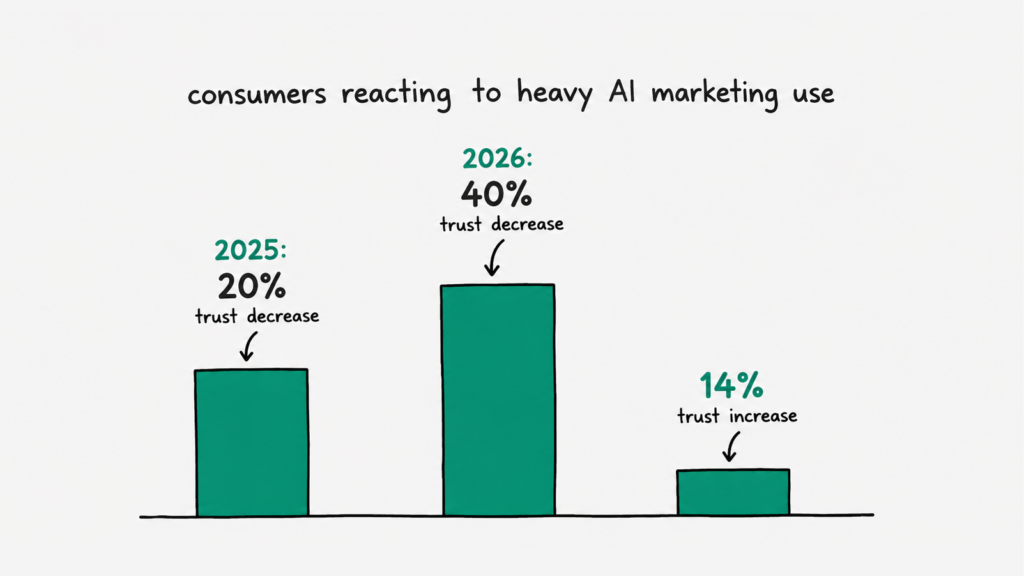
This shows up in trust, not just interfaces. Fractl’s 2026 AI trust research found that 40 percent of consumers say their trust in a favorite brand would decrease if that brand leaned heavily on AI for marketing, double the 20 percent who said the same in 2025. Only 14 percent said heavy AI use would make them trust a brand more. People are not rejecting AI. They are rejecting AI that feels like it is replacing a relationship instead of supporting one.
We saw this principle play out directly in our AI and NLP product work with Walmart Aspectiva (see the case study). The model can be excellent and still fail commercially if people do not understand or trust what it is doing. The differentiator was never the algorithm. It was whether the experience explained itself, recovered gracefully when something was wrong, and made the person using it feel more capable, not more confused.
If your AI feature is your entire pitch, you do not have a moat yet. You have a feature your best-funded competitor will copy by next quarter. The moat is the judgment wrapped around the technology, the part that is genuinely yours.
Tell a consistent story and every customer touchpoint
A product can be excellent and still lose to a worse product that tells one clear story everywhere a buyer encounters it: the landing page, the onboarding email, the support macro, the sales deck. Inconsistency reads as risk. Buyers do not consciously think “these do not match.” They just feel a flicker of doubt and go look at the next option.
Consistency is not the same as sameness. It means every touchpoint answers the same question in the same voice: what does this actually do for me, and why should I believe you? When we work through positioning with a founder, we test it the same way every time. Would a customer who read your landing page recognize your product inside your app three weeks later? If the answer is “not really,” that gap is costing conversions and referrals you will never trace back to the cause. Consistency across every touchpoint, from landing page to support ticket, is what an approach to building meaningful business products actually looks like day to day.
This matters more, not less, because of how skeptical buyers have gotten. Emplifi’s 2026 Digital Authenticity report found that 93 percent of consumers say authentic engagement builds trust, and 85 percent will pay a premium for brands they consider authentic. It also found the downside: 52 percent will stop buying after one experience that feels inauthentic. One inconsistent moment is not a small thing anymore. It is the thing that ends the relationship.
Be a brand people want to stick with
None of this works if the result feels like it was written by committee. The products people recommend to a friend have a personality: a specific tone, a willingness to say “we got this wrong” in a support email, microcopy that sounds like a person instead of a legal department.
This is where founders often lose their nerve right when it matters most. Investor decks and competitor research start to sand down every edge until the product sounds like everyone else’s product. Approachable does not mean informal for its own sake. It means the experience respects that a real person, with a real problem and limited patience, is on the other end of it.
Remember, you are not your user. But you can still write to them like a person who understands what they are going through, not a brand voice guideline trying to sound relatable.

Common mistakes when building meaningful business products
A few patterns we see often enough to call out directly:
Skipping the problem statement to get to the fun part, the actual building. Teams that do this usually end up doing a full rebuild eighteen months later, this time for real.
Treating AI as the differentiator instead of the delivery mechanism. The real differentiator is what you understand about your customer that a general model does not.
Letting different teams write different stories. Marketing promises one thing, the product delivers another, and support ends up apologizing for the gap in between.
Polishing away every distinctive detail in the name of looking professional. Professional and forgettable are not the same goal.
Each one is fixable, but only if someone senior enough is looking at the whole picture instead of just their own piece of it.
Key takeaways
- Know the problem you are solving in your customer’s own language before you build anything, especially before you add AI.
- AI features are table stakes now. The real differentiator is the judgment and trust built around the technology, not the technology itself.
- Consistency across every touchpoint, from landing page to support ticket, is what building meaningful business products actually looks like day to day.
- Authenticity has a measurable dollar value. Consumers pay a premium for it and abandon brands that fake it.
- Human, approachable products win because they respect that a real person with limited patience is using them.
Frequently asked questions
What does an approach to building meaningful business products actually mean?
It means building something people choose because it clearly solves their problem and consistently earns their trust, not because it happens to exist. In practice, that comes down to four things: a clear problem statement, honest differentiation, one consistent story across every touchpoint, and an experience that feels human rather than corporate.
How do you know if your product solves a real problem? Ask who loses sleep over this problem today and what they are doing instead of your product right now. If you cannot answer both without reaching for your pitch deck, the problem statement needs more work before the roadmap does.
Does AI make product differentiation harder or easier? Harder, in the sense that a good AI feature is no longer enough on its own. Easier, in the sense that it forces founders to get specific about what they actually understand about their customer that a general model does not. That specificity is where real differentiation lives now.
Is this approach only for early-stage startups? No. We see the same pattern in founders building a first product from zero and in established teams launching product number three or four. The size of the company changes the org chart around the decision, not the decision itself.
How do we get started building a more meaningful product? Usually with an honest conversation about the problem you are solving and who you are really solving it for. Get in touch and we will walk through where your product stands today and what is worth fixing first.