

“Life, Liberty, and the Pursuit of Good Design.”
If you are searching for a UI/UX design company in the USA right now, you are probably staring at a list of articles named things like “Top 15” and “Best of 2026” that all look the same. What you are actually looking for is a team that understands your target audience because they live inside it, and the plain convenience of working with people who share your time zone, your language, and your market. But what do you actually get with design in the USA?
What “in the USA” actually buys you
The “in USA” part of your search matters more than it sounds. Working with a US based UI/UX design company usually means real time zone overlap for live collaboration, a shared understanding of US ecommerce infrastructure and compliance expectations, and a design team that already speaks the language of your customers because they are often your customers too.

What most founders get wrong when they choose a UX design agency
Hiring any design company is a bet on a relationship you have not tested yet. You are trusting a group of strangers with your product, your brand, and a chunk of your budget, based mostly on a portfolio and a sales call. Even with the most reputable of agencies, there is always a risk.
Most founders choose a UX design agency the way they would choose a logo designer: by portfolio polish. That is understandable. Portfolios are the easiest thing to compare. They are also the least useful signal, because a beautiful screenshot tells you nothing about whether the underlying decisions actually drove revenue.
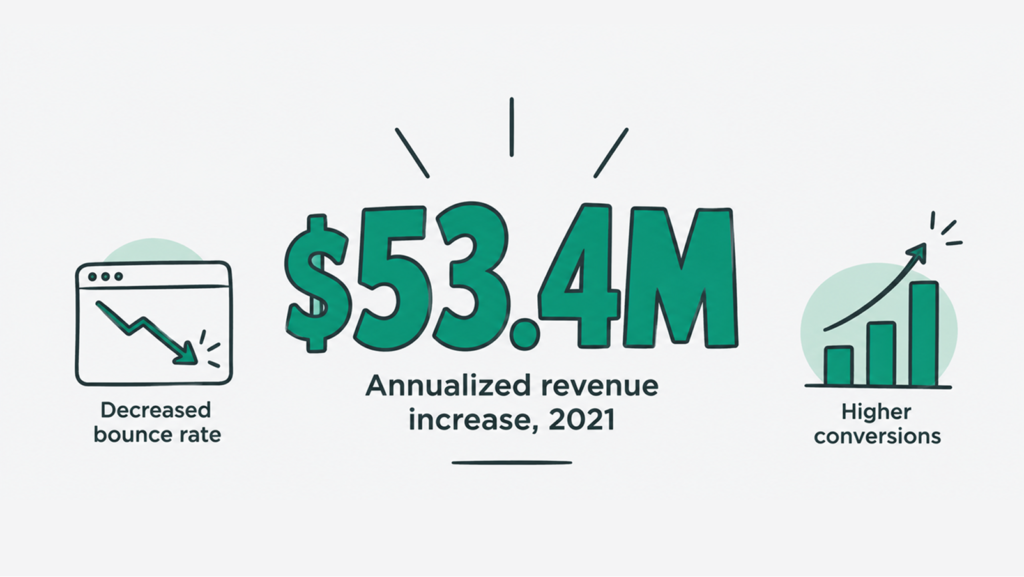
When we redesigned Lowe’s product and search listing pages, the visual changes were almost the least important part of the story. The real work was restructuring the information hierarchy so customers could actually find what they came for. Instead of navigating around banners and promotions that served internal stakeholders more than buyers. The result was a $53.4M increase in annualized revenue in 2021, along with decreased bounce rates and higher conversions. (see the full case study). None of that would show up if you were just comparing before and after screenshots in a portfolio.
That is the gap a portfolio cannot show you.
What the data says about the value of good design
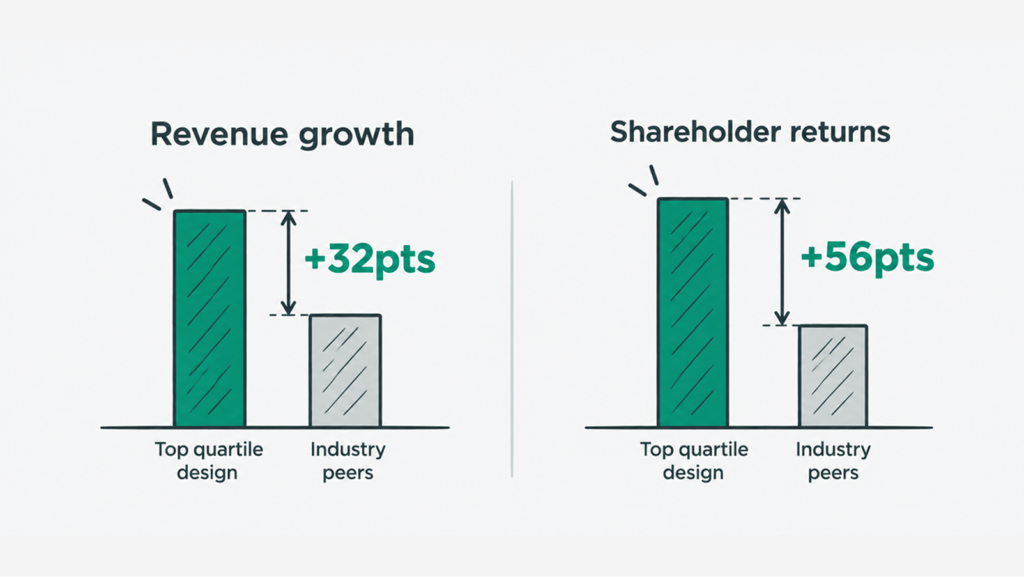
According to McKinsey’s Business Value of Design study, which tracked 300 public companies across medical technology, consumer goods, and retail banking over five years. Companies in the top quartile of design maturity achieved 32 percentage points higher revenue growth and 56 percentage points higher total returns to shareholders than their industry peers (McKinsey, 2018).
Here is the detail most people skip past: the performance gap between the second, third, and fourth quartiles was marginal. The market did not reward “pretty good” design. It rewarded genuine top quartile execution, and punished everything short of it almost equally.
That has a direct implication for how you choose a UI/UX design company in the USA. Competence is table stakes. What you are actually evaluating is whether a company is capable of the kind of execution that shows up in that top quartile, not just the kind that looks fine in a pitch deck.
Designed by the people for the people
Abraham Lincoln did not say much about product design, but the closing line of the Gettysburg Address describes exactly what good design is supposed to do: government of the people, by the people, for the people. Swap one word and drop one, and you have the whole discipline in a sentence. Designed by the people for the people.
That’s a great test for any design partner you are evaluating. Does their process center the people who will use the product, or does it center whoever is loudest in the room?
When we led navigation research and discovery for Lowe’s, the starting brief from internal stakeholders was simple: “customers say our navigation sucks.” That is not a design brief. It is a symptom. We pushed for access to real observational research tools that already existed inside the company but had never been given to the design team, then stack ranked the actual navigational issues against what customers reported, not what internal teams assumed (see the full case study). Aligning more than 50 directors, product leads, and business stakeholders around evidence instead of opinion was the real design win, long before a single new nav bar shipped.
A design company built for the people asks what your customers are actually experiencing before it asks what your homepage should look like.
What it costs to hire a UI/UX design company in the USA
Pricing varies more than most founders expect. According to Clutch’s 2026 pricing data, average hourly rates for US based UX design services run $100 to $149 an hour, with an average project cost around $85,000 and typical project ranges between $10,000 and $50,000 depending on scope. Full engagements average around 10 months from kickoff to launch.
You will also find offshore and junior teams charging $25 to $49 an hour. That is not automatically the wrong choice for every business. It is a different trade off: lower cost, usually less senior strategic input, and often less overlap with your working hours. Know which trade off you are making before you sign.
The number that should worry you more than the hourly rate is the McKinsey gap above. A cheaper company that produces second quartile design work is not actually the cheaper option once you count what it costs you in growth you never captured.
Red flags to watch for
Remember, the sales call is not the engagement. Watch for these before you sign anything:
No discovery phase before design begins. If a company can quote you a fixed price and timeline before asking a single question about your customers, that is a red flag, not efficiency.
They cannot name a specific, measurable outcome. “We design beautiful, intuitive experiences” is not an outcome. A revenue number, a conversion lift, a completion rate improvement is an outcome.
Junior only staffing after the pitch. The senior person who wowed you on the sales call should still be involved once the contract is signed, not handed off entirely to a team you have never met.
One process for every client. Your ecommerce checkout problem and a SaaS onboarding problem are not the same problem. A company that runs the identical process regardless of your business model has not actually built a process. It has built a template.
Key takeaways
- A UI/UX design company in the USA should lead with questions about your customers, not slides about their own awards.
- Portfolios show craft. They rarely show revenue impact, so ask for outcomes with real numbers attached instead.
- Time zone overlap and shared business context are genuine advantages of hiring domestically, but confirm exactly who is staffed on your account before you sign.
- Hourly rates for US design companies typically run $25 to $149+ depending on experience level and location, but the cheapest hourly rate is rarely the cheapest outcome.
- The best design partners build for one goal: designed by the people for the people, meaning every major decision traces back to real customer behavior, not internal opinion.
Frequently asked questions
How much does it cost to hire a UI/UX design company in the USA? Based on 2026 industry pricing data, expect $100 to $149 an hour for experienced US based teams, with average full project costs around $85,000 and typical ranges between $10,000 and $50,000 depending on scope. Offshore or junior teams run lower, often $25 to $49 an hour, with different trade offs in seniority and time zone overlap.
What is the difference between a UI/UX design agency and a freelancer? An agency gives you a team with overlapping skills (research, UX strategy, UI design, sometimes development) and continuity if one person is unavailable. A freelancer can be a strong fit for smaller, well scoped projects, but you are relying on one person’s bandwidth and range. The right choice depends on how much strategic ownership you need versus pure execution.
How long does a typical UI/UX design project take? Full engagements average around 10 months from kickoff to launch, though scope changes this significantly. A focused audit or specific feature redesign can move much faster than a full product or platform redesign.
What questions should I ask before hiring a UX design agency? Ask who specifically will work on your account day to day, what their discovery process looks like before any design work begins, and for a named, measurable outcome from a past engagement. If they cannot answer any of these with specifics, treat that as your answer.
How do I know if my product actually needs a UX design company right now? If you have traffic and product momentum, a site or product that is “fine” but not converting the way it should, and no one senior enough in house to translate customer behavior into a clear roadmap, that is usually the moment. Looking for a UX partner who understands both design and business outcomes? We work with ecommerce brands and startups from seed to scale. Get in touch.