
If you’ve started researching UI/UX design agency costs, you’ve probably already noticed that the numbers make no sense. One source says $10,000. Another says $150,000. A third says “it depends” and leaves you nowhere.
That range is not a mistake. It reflects something real about how differently agencies structure their work, what they include in a quote, and what “UI/UX design” actually means depending on who you’re talking to. The problem is that without a framework for reading those numbers, you cannot tell the difference between a quote that is appropriately priced for what it includes and one that is cheap because it leaves out the work that makes everything else function.
This post gives you the real ranges, sourced from verified market data, broken down by what each tier actually buys you. And then it goes one step further. Because in our experience working with ecommerce brands and startups from seed to scale, the founders who get the most from a UI/UX agency investment are not always the ones who found the best price. They are the ones who understood what they were buying before they signed anything.
What UI/UX design agencies actually charge: the real numbers
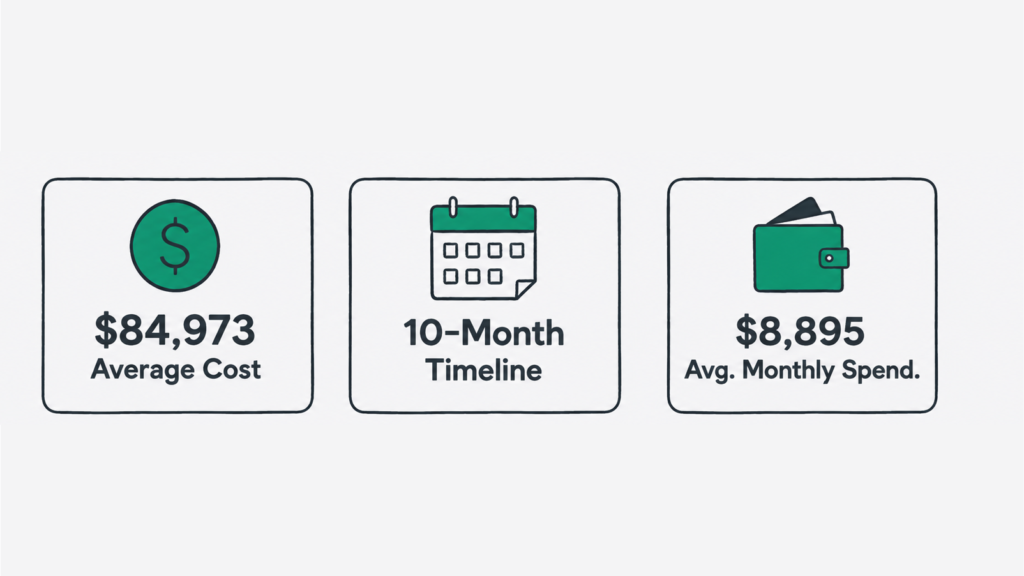
Let’s put the numbers on the table directly. According to verified project data from Clutch, the average cost for a UI/UX agency engagement is $84,973, with a typical timeline of 10 months and an average monthly spend of $8,895. That is the middle of the market. Here is what the full range looks like, and more importantly, what each tier includes.
Hourly rates by agency type (US market, 2026)
Hourly rates vary significantly based on team seniority, location, and specialization. Based on Clutch marketplace data and verified agency rate sources as of early 2026:
- Offshore teams (India, Latin America): $25–$65/hr. Lower hourly cost, but requires more internal project management on your end. Quality varies widely. Communication overhead is real.
- Mid-market US specialists: $100–$149/hr. This is where most founder-stage projects land. You’re getting experienced designers, but you’re not paying for a large account team.
- Senior boutique studios: $150–$250/hr. Smaller teams, higher seniority, often more strategic involvement. Less overhead, more direct access to the people doing the work.
- Highly specialized firms or enterprise-focused agencies: $200–$300/hr. Justified when you have compliance requirements, complex regulated environments, or a platform at a scale that demands it. For most growth-stage companies, this tier adds overhead instead of value.
Project-based pricing: what each scope actually buys
Hourly rates matter less than you think. Most engagements are scoped as fixed projects or monthly retainers, and that is where you need to understand what the dollar amount includes.
$5,000–$15,000 Wireframes, basic UI screens, or a single user flow. No UX research. No usability testing. This tier is useful for quick visual validation of something already well-defined. It is not the right investment for building a product users will keep using, or for diagnosing why your existing product is underperforming.
$15,000–$50,000 A full-featured engagement: user research, UX flows, responsive UI design, and a starter component library. According to Orbix Studio’s 2026 pricing analysis, a mobile app MVP with 15 to 25 screens typically falls in the $15,000–$40,000 range. Most early-stage product design projects live here. This is also where scope ambiguity causes the most damage. A $20,000 quote that does not include research is a fundamentally different engagement than a $20,000 quote that does.
$50,000–$150,000 Complex platform design: multiple user roles, custom workflows, design system builds, or significant UX research components. Dribbble’s 2026 agency pricing guide notes that project-based pricing in this range typically covers discovery, UX, UI, and developer handoff for mid-sized products. Enterprise-grade agencies with large account teams sit at the higher end of this bracket.
$150,000+ Enterprise-grade work: regulated industries, platforms serving thousands of users with different permission levels, compliance requirements, or AI integration. The complexity is real. So is the team size required to handle it.
Retainers: $3,000–$30,000+/month Ongoing design partnerships. Weekly sprints, continuous UX research, design system maintenance, and async collaboration. The right model for teams actively shipping. The range is wide because a boutique studio running focused weekly sprints and an enterprise agency with a dedicated account team are very different products.
What drives the price up
The factors that push quotes higher are worth understanding before you brief an agency. Project complexity is the biggest driver, but it is not the only one. The number of screens, user roles, and research depth all add cost. Platform requirements (web, mobile, or both) matter. Accessibility and compliance standards add time. Revision rounds beyond what is scoped add cost at every agency. And location still matters: a senior designer in San Francisco costs more to employ than one in Buenos Aires, and agencies pass those costs through.
The factor that causes the most unexpected budget growth is scope left ambiguous at the start. The most consistent source of friction in fixed-fee engagements, as Fuselabs’ 2026 pricing guide notes, is a feature not in the original brief, or additional stakeholder feedback rounds that reopen settled decisions. Clear requirements at the outset are how you protect your budget.
The question that actually matters: what is the problem costing you
Here is where most conversations about agency pricing go wrong. Founders compare hourly rates across agencies with fundamentally different team compositions, deliverable depths, and research inclusions. They make a decision on price. And then they wonder why the output did not move the metrics.
The number is not irrelevant. But it is the wrong place to stop thinking.
McKinsey tracked 300 public companies over five years and found that top design performers achieve 32% faster revenue growth and 56% higher total returns to shareholders than their industry peers. Forrester’s research on UX investment found that every $1 invested in UX returns $100, driven by higher conversions, reduced development rework, and lower support costs.
Those numbers are not abstract. We have seen what they look like in practice.
When we redesigned Lowe’s product and search listing pages, the core problem was not the products themselves. It was that customers could not find what they came for. By restructuring the information hierarchy and removing content that was crowding out buyer intent signals, we saw immediate results: decreased bounce rates and a $53.4M increase in annualized revenue for 2021. See the full case study.
When we built next-generation visualizer tools for Lowe’s flooring and paint category, the goal was to reduce purchase uncertainty for high-consideration products. The result was a 50% increase in conversion rate and $500K in additional weekly revenue. See the full case study.
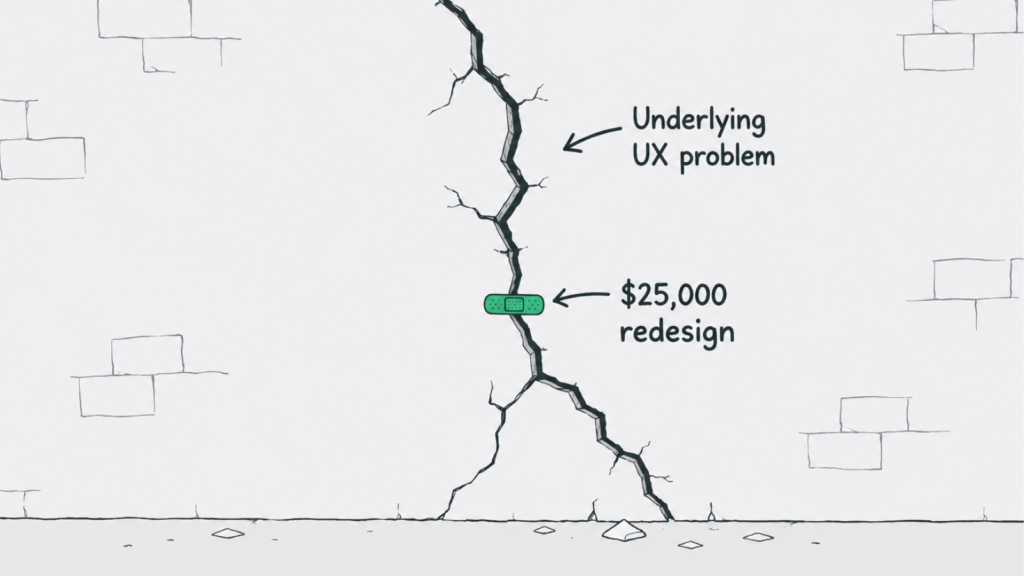
A $25,000 redesign that does not address the underlying UX problem is more expensive than a $60,000 engagement that meaningfully improves acquisition, retention, or product adoption. The question worth asking before you evaluate any quote is: what is this problem costing us right now?
If your checkout abandonment rate is eating into your potential revenue every single day, the agency that charges $80,000 and fixes it is a better investment than the one that charges $20,000 and makes the screens look better.
The line item founders cut most often
In our audit work, the budget item that gets removed first is UX research. It feels optional, slow, and, It feels like something you can skip if you already know your users pretty well.
It is the single factor that determines whether everything else works.
Research is what tells you whether you are solving the right problem. Without it, you are designing solutions to symptoms. You change button colors when the real issue is trust, you simplify the checkout when the real friction is three screens earlier. You build a feature no one asked for and wonder why retention is flat.
Forrester’s research on continuous UX testing found that organizations that invest in it improve revenue retention by up to 10.8% over three years. That compounds. The agencies that include research in their scope are not padding the budget. They are protecting your outcome.
Five questions to ask before you sign anything
Before you evaluate an agency quote purely on price, ask these:
1. What does research look like in this engagement? If research is not in the scope, you are buying execution without diagnosis. That works for well-defined problems with validated solutions. It does not work for a product that is underperforming and you are not sure why.
2. Who is actually doing the work? Large agencies often win the pitch with senior partners and deliver with junior designers. Boutique studios are often the opposite. Ask who will be in your Figma file every week and what their background is.
3. What does this engagement produce at handoff? Screens are not enough. You need developer-ready assets, a component library, and documented design decisions. Anything less creates expensive ambiguity at the engineering stage.
4. How do you handle scope changes? Every agency has an answer. The good ones have a clear addendum process. The ones to be cautious about offer “unlimited revisions” without explaining what a revision round actually means or how it is priced when you go beyond it.
5. Can you show me work that moved a business metric? Portfolio work that is beautiful is table stakes. You want to see what happened after launch. Conversion rate lift. Retention improvement. Revenue impact. An agency that cannot connect their design work to a business outcome is not the partner you need.
What good value actually looks like
Good value in UI/UX design is not the lowest price. It is the best return on the investment.
The founders and product leaders who get that return are the ones who enter an agency relationship with a clear problem, a reasonable scope, and a partner who understands that design is a business decision. They do not cut research. They do not scope for screens when they need strategy. And they do not evaluate quotes without asking what the deliverable actually includes.
The ranges in this post are real and sourced. They are a starting point. What you are actually buying inside those ranges is what determines whether the investment pays off.
If your product is underperforming and you are not sure where to start, that is exactly the kind of problem we work on

Key takeaways
- UI/UX agency hourly rates in the US run from $100–$300/hr depending on seniority and specialization. Offshore teams run $25–$65/hr with higher management overhead on your end.
- Project-based engagements typically range from $15,000 for a focused MVP to $150,000+ for complex platform design. Clutch verified data puts the average agency project at $84,973.
- The price varies based on project complexity, research depth, number of screens, platform requirements, and how clearly the scope is defined at the start.
- The agencies charging more for UI/UX design are often including research, strategy, and systems work that lower-priced quotes leave out. Compare what is in the scope, not just the total.
- McKinsey and Forrester data consistently shows that design investment produces outsized returns. The right question before evaluating any quote is: what is the problem costing us right now?
FAQ
What is the average cost to hire a UI/UX design agency? According to verified project data from Clutch, the average cost for a UI/UX agency project is $84,973 with a typical timeline of 10 months. That said, project costs range from $15,000 for a focused MVP engagement to $150,000 or more for complex platform design. The range is wide because “UI/UX design” covers very different scopes. What drives the number is project complexity, research depth, team seniority, and how clearly defined the deliverables are from the start.
Why are UI/UX agency quotes so different from each other? Because they often include fundamentally different things. One quote might cover wireframes and visual UI. Another includes user research, usability testing, a design system, and developer handoff assets. A third structures the work as ongoing monthly sprints rather than a one-time project. Before comparing quotes, confirm what each one includes in terms of research, deliverables, revision rounds, and handoff documentation. The hourly rate is a poor comparison point if the scope is different.
Is it worth paying more for a UI/UX agency with higher rates? It depends on what the higher rate buys. Senior boutique studios charging $150–$250/hr often deliver more strategic involvement and fewer management layers than a large agency at a similar total project cost. The more useful question is whether the agency can show you design work that moved a business metric. Portfolio work that is beautiful but disconnected from outcomes is a warning sign regardless of the price.
What should I expect to get at the end of a UI/UX design engagement? A complete engagement should include developer-ready design files, a component library or design system, documented design decisions, and if research was in scope, the research outputs that informed the design choices. Screens alone are not enough. Ambiguity at handoff creates expensive rework at the engineering stage, and that cost does not show up in the original quote.
How do we know if we’re ready to hire a UI/UX design agency? The signal we see most often is this: you have traffic, some product momentum, a website or product that is “fine,” enough budget to improve, and no real clarity on what to fix first. That is the moment a senior design partner pays for itself quickly. If you are not sure where the friction is, that uncertainty is itself a reason to start the conversation. Get in touch and we can talk through it.