
You know you need help with design because your product has grown past what your current team can handle. Conversion rates are flat. Users are dropping off somewhere in the funnel and no one can agree on why. You’ve tried patching things — tweaking copy, rearranging buttons, running A/B tests that keep coming back inconclusive.
What you actually need is a real design partner. Someone who can look at what you’ve built, understand who you’re building it for, and tell you with confidence what needs to change and why.
So you start searching for the right design firm. And that’s where it gets complicated.
The options are overwhelming. Portfolios look impressive. Every agency says they’re strategic and user-centered and focused on business outcomes. So how do you tell the difference between a firm that will actually move your metrics and one that will hand you beautiful mockups that don’t solve anything?
This is the guide we wish our clients had before they called us.
Why hiring the wrong design firm is so expensive
Most founders and operators underestimate the cost of a mismatched design engagement. Not just the invoice — the cost of time, of shipping the wrong thing, of going back to rebuild.
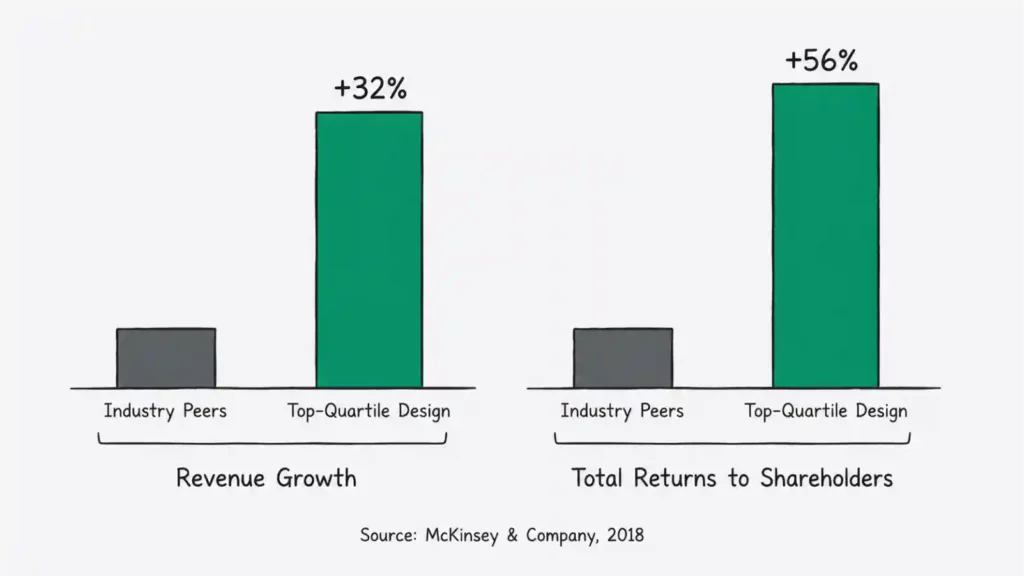
McKinsey & Company tracked the design practices of 300 publicly listed companies over five years, collecting more than two million pieces of financial data. Their research is still one of the most cited studies on the relationship between design and business performance. What they found was striking: companies in the top quartile of their Design Index saw 32% higher revenue growth and 56% higher total returns to shareholders compared to their industry peers over that same five-year period. (McKinsey & Company, “The Business Value of Design,” 2018)
That gap does not come from having more designers. It comes from how design is practiced. In the same study, over 40% of the companies surveyed were not talking to their end users during product development. Just over 50% had no objective way to assess the output of their design teams.
In other words: most companies are guessing.
The right design firm stops the guessing. The wrong one formalizes it with higher production quality.
When we redesigned the product and search listing pages for Lowe’s, the core problem was not the visual design. The pages functioned. But customers couldn’t find what they came for. Internal banner content was competing with buyer intent. The information hierarchy was designed around what stakeholders wanted to promote, not around what customers needed to decide. We restructured that hierarchy, reduced friction, and improved the mobile experience. The result was a $53.4M increase in annualized revenue in 2021 and decreased bounce rates across the board. That outcome came from diagnosing the right problem first — not from making something look better.
A design firm that cannot diagnose before it designs is a firm that gets paid to guess.
What to look for when choosing a design agency
Most evaluation guides will tell you to review portfolios, check Clutch reviews, and compare pricing. Those things matter. But they are not where the real signal lives.
Here is what actually reveals whether a firm is worth hiring.

1. They ask about your business outcomes, not just your deliverables
In the first conversation with a design firm, listen for what they ask. A firm focused on doing the work will ask about timelines, platforms, number of screens, and asset handoff. A firm focused on your outcomes will ask about your conversion rates, your retention, your biggest friction point in the funnel, and what would happen to the business if that problem got solved.
Both types of firm will produce design files. Only one of them will produce a material change in your numbers.
2. Their case studies include results, not just visuals
Pretty portfolio screenshots are easy to come by. What is harder to find is a firm that can tell you: here is the problem the client had, here is what we changed, and here is what moved.
When you review case studies, look for specificity. Not “we redesigned the checkout experience and improved conversion.” Ask: by how much? In what timeframe? Against what baseline? If the firm cannot or will not answer those questions, it likely does not know the answer. And if they do not know the answer, they were not paying attention to the outcomes.
3. They push back when you are wrong
This is uncomfortable to hear, but an agency that agrees with everything you say is not a partner. They are a vendor.
The best design work happens when a firm has enough expertise and enough confidence to tell you when your instinct conflicts with what users actually need. We have told clients their navigation is not the problem when they were convinced it was. We have redirected scope away from visual redesigns toward information architecture fixes that did not look as impressive in a Figma file but produced measurable results.
A firm that never pushes back is one that optimizes for your approval, not your outcomes. That is worth remembering when you are evaluating proposals.
4. They can explain their process clearly
Design without process is guessing with a style guide.
Ask any firm you are considering to walk you through how they work. Not what they deliver. How they work. Where does research happen in the process? At what point do they talk to actual users? How do they decide what to prioritize? What does their handoff to development look like?
If a firm hesitates on these questions or gives you a vague answer about being “collaborative and iterative,” that is a signal. A firm that has done this work at scale knows exactly how they operate.
5. They are not the cheapest option
This one tends to land badly, so we will say it plainly: quality UX design takes time, senior-level judgment, and a real process. Firms that are significantly cheaper than everyone else are cheaper for a reason.
That does not mean you need the most expensive agency in the room. But if a proposal comes in at a fraction of comparable quotes, ask what is being cut. Is it research? Senior design time? Iteration? Understanding what is absent from a cheap engagement is as important as understanding what is present in an expensive one.
How to choose a UX design agency for ecommerce specifically
If you are an ecommerce brand, the criteria above still apply. But there are additional things worth looking for.
They understand the full commerce experience, not just the visual design. Ecommerce UX is not about making your product pages look good. It is about reducing the uncertainty buyers feel before they commit. It is about building trust at every moment in the funnel — from the first time someone lands on your site to the moment they click purchase.
We designed visualization tools for Lowe’s that allowed customers to see how flooring and paint would look in their own uploaded room photos. That project came from understanding a very specific buyer problem: people were not converting on high-consideration home products because they were afraid of making an expensive mistake they could not undo. The result was a 50% increase in conversion rate and $500K in additional weekly revenue. That outcome was possible because the design solution came from the customer problem, not from a brief about making the visualizer look better than the competitor’s.
A design firm that understands ecommerce understands buyer psychology. They think about hesitation, not just navigation.
They know the difference between mobile and desktop UX. Ecommerce traffic is overwhelmingly mobile. But most design teams build for desktop and adapt for mobile as an afterthought. If a firm cannot speak specifically to how their work addresses mobile-first behavior, that is a gap worth probing.
They have experience shipping — not just designing. Ecommerce moves fast. You need a firm that understands the constraints of actually implementing design, not one that produces beautiful work that never survives the handoff to development.
The questions to ask in the first conversation
When you get on a call with a design firm you are evaluating, here are the questions that will tell you the most.
“Walk me through a project that did not go as planned. What happened and what did you do?”
How a firm talks about difficulty reveals more than how they talk about success. You want honesty, self-awareness, and evidence that they adjusted rather than blamed.
“What is your process for understanding the user before you start designing?”
If the answer involves skipping research to save time or budget, note it. Research is not a phase that can be removed without cost. It gets paid for either in time upfront or in rework later.
“How have you pushed back on a client and what was the outcome?”
This surfaces whether the firm operates as a strategic partner or a vendor. If they struggle to answer or cannot name a specific example, the answer is vendor.
“What metrics did your last three engagements move?”
A design firm that tracks outcomes should be able to answer this. It does not have to be a dramatic number. But they should know whether their work had an effect — and how they know.
Common mistakes when hiring a design firm
We have seen founders make the same mistakes repeatedly. Here is what to avoid.
Hiring before you know what you are trying to solve. “We need a redesign” is not a brief. Before you talk to any firm, get specific: what is broken, what is the cost of leaving it broken, and what would success look like in measurable terms? Clarity at the brief stage filters out mismatched proposals and prevents scope creep later.
Choosing on portfolio aesthetics. Visual execution is one piece of what a design firm does. A portfolio that looks stunning tells you the firm can produce high-fidelity output. It does not tell you whether they can diagnose the right problem, conduct meaningful research, or connect design decisions to business outcomes.
Treating the engagement as fully outsourced. A design firm is not a team you hand a project to and check in on six weeks later. The best engagements are collaborative. You know your customers, your business, and your constraints better than any outside partner ever will. A firm that does not want your ongoing input is one that does not understand how good design actually works.
Not asking about research. If a firm skips user research to reduce cost or timeline, the design will be based on assumptions. Sometimes those assumptions are right. Most of the time, they are the same assumptions your internal team already has — which means you are paying for someone to formalize the guesses you were already making.
Key takeaways
- Design drives real business outcomes. McKinsey’s research found top-quartile design performers saw 32% higher revenue growth over five years compared to their peers. The right design firm is not a cost center. It is a growth investment.
- Evaluate process, not just portfolio. A firm that cannot clearly explain how they work cannot consistently produce the outcomes their portfolio implies.
- The right firm will push back. If every conversation ends with the firm agreeing with your brief, you are not getting a partner. You are getting a vendor with good tools.
- Clarify the business problem before you start. Know what you are trying to fix and how you will measure whether it got fixed. That clarity is the foundation of a useful design engagement.
- Cheap design costs more. The cost of rework, of shipping the wrong thing, of a misdiagnosed problem is almost always higher than the difference in proposal price between a firm with a real process and one without.
FAQ
How much does it cost to hire a design firm?
Pricing varies widely depending on scope, firm size, and engagement model. A UX audit from a boutique studio might run $5,000–$20,000. A full product redesign or ongoing design partnership can range from $30,000 to well over $150,000. The more important question is not what it costs but what the problem is costing you without a solution. If flat conversion rates or high drop-off are costing you $50K a month in lost revenue, a $25K design engagement is not an expense. It is a return.
What is the difference between a UX design agency and a branding agency?
A branding agency works on identity: your logo, visual language, color system, and how your company presents itself to the world. A UX design agency works on experience: how your product or website actually functions for the people using it. The two are related but not the same. When conversion is the problem, brand polish will not fix it. You need someone focused on user behavior, friction, and the decisions buyers make inside your product.
How long does a typical design engagement take?
A focused UX audit typically takes two to four weeks. A product redesign can take three to six months, depending on scope and how quickly decisions get made. If a firm promises a major design project in two weeks, ask what is being skipped. Good design takes time because good research, synthesis, and iteration take time.
Should I hire a design firm or a freelancer?
For contained, well-defined projects, a strong freelancer can be the right call. For complex products with multiple user types, real business stakes, and a need for cross-functional alignment, a firm with a full team and a structured process is usually worth the difference in cost. The question is whether the problem is a task or a strategy problem. Tasks can be freelanced. Strategy problems need a partner.
How do I know if a design firm is right for my ecommerce brand?
The clearest signals are: they can talk specifically about buyer psychology and purchase hesitation, they have done work at the intersection of commerce and UX (not just general digital design), and they ask about your conversion data before they start talking about what they would build. If they jump straight to design solutions before understanding your business, keep looking. If you are ready to talk through what your product specifically needs, we would love to hear from you.
Sources and further reading
- McKinsey & Company. “The Business Value of Design.” 2018. h
- The Growth UX Studio. “Lowe’s Product and Search Results Listing.” 2021.
- The Growth UX Studio. “Lowe’s Flooring and Paint Visualizers.” 2022.
Ready to talk?
Looking for a design partner who understands both design and business outcomes? We work with ecommerce brands and startups from seed to scale — and we always start with the problem, not the pixels. Get in touch.