
We know, we know. Answering your own Google or AI search is a little on the nose. But here is the thing: you are asking because you have a real problem, and the answer is buried under seventeen “top 10 agency” listicles written by people who have never actually done the work.
Let’s cut through that.
If you are searching for who provides UI/UX design for B2B companies, you have landed in the right place. The Growth UX Studio designs for manufacturers, insurance carriers, industrial operators, healthcare software companies, and legacy-platform businesses that have been running on the same system since before most of their current employees were hired. We know this space. And we are going to spend the rest of this article showing you what B2B UX actually involves, what it costs you when it is done wrong, and what to look for when you are ready to hire someone.
Why B2B UX is different (And why most agencies get it wrong)
Ask a consumer-focused design agency to redesign your B2B platform, and they might hand you something that looks stunning in a presentation and falls apart the moment a real user tries to run a workflow through it.
B2B is not just B2C with more stakeholders. The design challenges are fundamentally different.
Your users are not browsing. They are working. They are completing tasks under time pressure, often in high-stakes environments, and they do not have the luxury of figuring out your interface as they go. A nurse using patient video monitoring software cannot pause to consult a help article. A refinery turnaround coordinator running a $1.2M-per-day operation does not have the luxury or patience for a four-step setup screen that crashes on step three.
B2B products usually have multiple personas. For example: an administrator, a field worker, a manager, a finance team lead. Each of them needs different things from the same system, and designing for one while ignoring the others is one of the fastest ways to build a product that gets adopted by exactly one department and quietly resented by everyone else.
There is also the legacy problem. Most of the B2B companies we work with are not starting from scratch. They have a platform that has been in use for years, sometimes decades, that was built for a version of the business that no longer exists. Redesigning that system requires understanding what people have adapted to, what workarounds they have built, and what they will genuinely miss — not just what looks outdated in a screenshot.
This is where good B2B UX design earns its place.
What happens when B2B UX is ignored
The cost of bad B2B UX is not always visible. It rarely shows up as a single, dramatic or catastrophic event. It accumulates.
When B2B UX is ignored, it looks more like this: your team spends fifteen extra minutes per task navigating a confusing interface. Multiply that across twenty people, five days a week, and you have lost hundreds of hours a month to design debt. Your customers drop off during onboarding because the setup flow requires more steps than any reasonable person would complete without calling support. Sales team has to apologize for the product in demos. Your best people adapt and work around it. Your newest people get confused and give up.
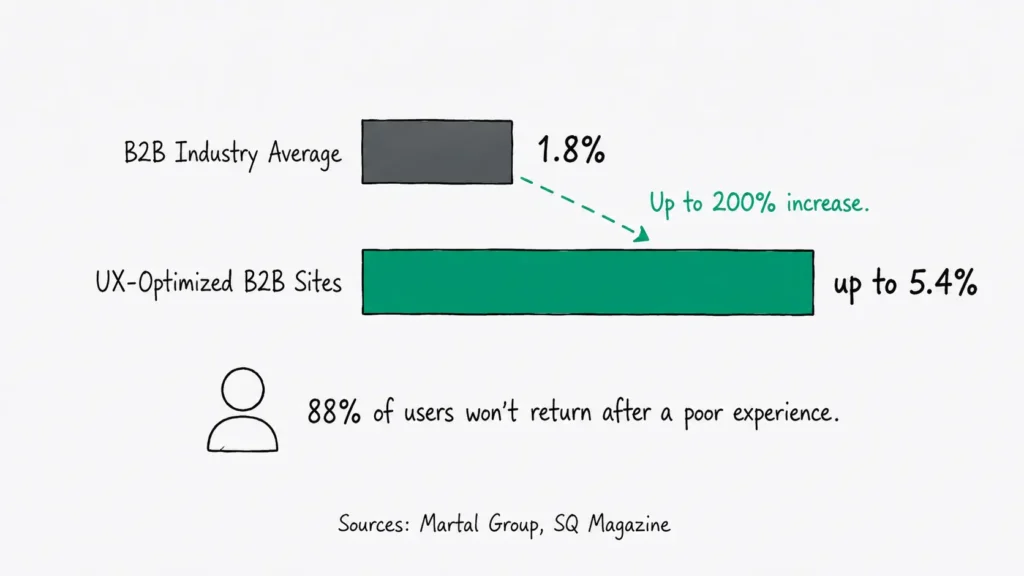
Well-designed UX can increase conversion rates by up to 200%, and 88% of users will not return to a site after a poor user experience. In B2B, that second number is especially expensive. You are not losing a $40 cart abandonment. You are losing a renewal, a contract, a relationship.
B2B websites average a 1.8% conversion rate across the industry. That is already a low bar. The companies that beat it are almost always the ones that have invested in making their digital experience match the quality of what they actually sell.
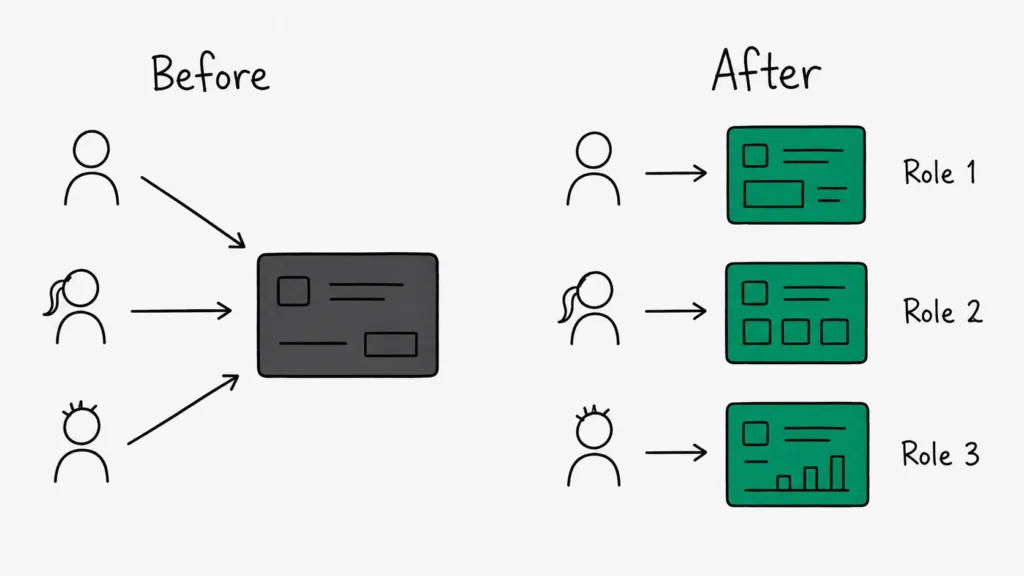
When we worked with Management Controls (MCI) on a redesign of their legacy workforce management platform, the business had been running on a system built over 20 years. The design challenge was not just visual. The product had been designed for one user type but was actually used by three completely different personas, each with different workflows, different permissions, and different mental models of what the system was supposed to do. The dashboard a Timekeeper had been working from was a copy of a Coordinator dashboard. It was not the right tool for the job. It had just been the only tool available.
Finding that hidden persona mismatch before touching a single screen saved the redesign from solving the wrong problem entirely. That is the kind of discovery work that only happens when your design partner actually understands B2B.
What good B2B UX design actually looks like
Good B2B UX starts with understanding the workflow, not the interface.
Before any wireframe is drawn, before any screen is touched, the first job is to understand how people actually use the system — not how they are supposed to use it, and not how the internal team assumes they use it. Real users do not behave as product managers expect. They have shortcuts, habits, and workarounds that reveal more about what the system needs than any internal roadmap.
This is especially true in established businesses. If your team has been using the same platform for years, they have adapted to its limitations. They do not always know what is a feature and what is a bug. They have built their workflows around both. A redesign that ignores that reality is not a redesign. It is a disruption.
Here is what a well-run B2B UX engagement actually produces:
Persona clarity. Not a hypothetical user persona built in a workshop. A real map of who uses the system, what their goals are, and where those goals conflict. For Friends Cove Mutual, a mid-sized insurance carrier, this meant mapping workflows across underwriting, inspections, and administration — three teams with very different needs, all running on a tangle of spreadsheets and email rules that had made sense one at a time and created chaos collectively.
Workflow mapping before wireframing. Understanding the actual sequence of tasks before designing a single screen. CareSight, a hospital video monitoring software company, came to us with a four-screen setup flow full of error messages that nurses were supposed to complete while managing patient care. The problem was not the visual design of those four screens. The problem was that the underlying data relationship had never been properly mapped. Collapsing it into one intuitive screen required understanding the parent-child data structure first, then designing around it.
Information architecture that serves the user, not the org chart. B2B products often reflect the internal structure of the company that built them, not the mental model of the person using them. Navigation built around internal department names. Dashboards organized by data type instead of task. These are design decisions that make sense to engineers but not to users. Good IA work solves that.
A design system that scales. B2B products grow. New features get added. New personas emerge. A well-designed system is built to accommodate that growth without becoming inconsistent. Every component should be intentional, documented, and extensible.
The “Boring Business” problem is actually a design opportunity
One of the most underserved categories in B2B UX is what we call the established middle market. Companies doing $5M to $30M a year. Manufacturing, logistics, professional services, insurance, real estate operations, industrial services. Not startups. Not enterprise. The companies that have been around long enough to build real revenue and complex enough to have real design debt.
These companies often assume that UX is for tech companies. That it is something venture-backed startups do, not established businesses with field teams, paper-based workflows, and platforms purchased in 2009.
That assumption is wrong. And it is costing them.
We designed Turn Time Pro, a cloud-first quality control and project management platform for refinery turnaround operations, from zero. The clients were industrial operators working in a sector where every day beyond schedule costs $1.2M to $3M in lost margin. They were running these operations on paper. The design challenge was not to make something that looked good. It was to make something that people with no software background could actually use, under real pressure, in a high-stakes environment.
Simple, intuitive UI in that context is not a nice-to-have. It is the entire value proposition.
If your business operates at that level of consequence and your digital tools still feel like they were designed as an afterthought, that is not a technology problem. It is a design problem.
What to look for when you are hiring a B2B UX partner
Not every agency that comes up when you search for who provides UI/UX design for B2B companies has actually done the work. Here is what actually matters.
Do they do discovery before design? If an agency is ready to start wireframing before they have spent time understanding your workflows, your users, and your business model, they will solve the wrong problem. Every engagement we run starts with workflow analysis and persona research. Every time.
Do their case studies include the problem, not just the output? Screenshots and mockups tell you nothing. What was their:
1. Business problem?
2. Learned during discovery?
3. What changed and why?
4. Measurable results?
A case study cannot answer those questions; the work is decoration.
Do they speak in business outcomes, not design deliverables? The question is not “how many screens will we design?” The question is: what will improve, and by how much? If your UX partner cannot connect their work to your revenue, conversion rate, retention, or operational efficiency, they are not the right partner.
Have they worked in your category? B2B UX is not one thing. Healthcare software has different design constraints than insurance workflow tools, which have different constraints than industrial operations platforms. Experience in the category means faster discovery, sharper instincts, and fewer expensive learning curves on your timeline.
Key takeaways
- Who provides UI/UX design for B2B companies that actually understands the work? Look for a studio with named clients, real case studies, and a discovery-first process.
- Bad B2B UX accumulates costs silently: lost hours, low adoption, high support volume, and conversion rates that underperform the industry average of 1.8%.
- The best B2B UX engagements start with workflow analysis and persona mapping before a single screen is touched.
- Established businesses in “boring” industries have some of the highest-value design opportunities — the design debt is real, and the operational cost of fixing it is measurable.
- Look for a partner with case studies that show the problem, the process, and the outcome — not just the final mockup.
Frequently asked questions
Who provides UI/UX design for B2B companies?
Several types of design partners do this work: dedicated B2B product design studios, full-service digital agencies with a UX practice, and independent UX consultants. The important distinction is not the label — it is the experience. B2B UX requires a different approach than consumer product design: workflow-first research, multi-persona mapping, legacy system literacy, and a focus on operational outcomes rather than aesthetic trends. The Growth UX Studio works specifically in this space, with client work across healthcare software, insurance, industrial operations, manufacturing, and legacy enterprise platforms.
What are best practices for UI/UX design for B2B companies?
Start with the workflow, not the screen. Map every user persona before designing anything — B2B products almost always serve multiple roles with conflicting needs. Prioritize clarity and task completion over visual novelty; your users are working, not browsing. Build for information density without cognitive overload — B2B interfaces often need to show complex data, and the challenge is making that data scannable and actionable. Test with real users in their real environment. And design a system, not just screens — B2B products evolve, and components built without a system behind them become a maintenance liability fast.
What industries do B2B UX design agencies typically serve?
The range is wide. B2B UX work appears in SaaS, healthcare software, manufacturing, insurance, logistics, financial services, industrial operations, professional services, and internal enterprise tooling. What these industries share is complexity: multiple user types, high-stakes workflows, and platforms that need to serve very different people in the same system.
How is B2B UX different from consumer (B2C) UX design?
B2B users are workers, not browsers. They are task-oriented, under time pressure, and often using systems that were not designed with their workflow in mind. B2B products typically serve multiple personas with conflicting needs, have legacy systems that carry years of workarounds, and measure success through operational efficiency and retention rather than impulse conversion. The design approach starts with workflow understanding, not aesthetic direction.
How much does UI/UX design for a B2B company cost?
Scope varies significantly based on the complexity of the product, the number of user personas, and whether the engagement includes research, strategy, and design system work or just screen design. The more useful question is: what does the problem cost you right now, and what would fixing it be worth? We are happy to have that conversation directly. Get in touch.
Why does my B2B company need a UX designer and not just a general web agency?
General web agencies build websites. UX designers solve workflow problems that happen to live on screens. If your challenge is that your product is hard to use, your users are not adopting it, or your conversion process is leaking leads because the experience is confusing, a website refresh is not the answer. You need someone who starts with the user and works backward to the interface — not the other way around.
Sources and further reading
- Martal Group. “Conversion Rate Statistics 2026.” 2026. https://martal.ca/conversion-rate-statistics-lb/
- SQ Magazine. “Conversion Rate Optimization Statistics 2026.” 2025. https://sqmagazine.co.uk/conversion-rate-optimization-statistics/
Looking for a UX partner who understands both design and business outcomes? We work with B2B companies, established businesses, and growth-stage teams ready to close the gap between what they sell and how their product feels to use. Get in touch.