
Remember what the Cheshire Cat said to Alice in Wonderland? “If you don’t know where you’re going, any road will get you there.”
Product discovery is how you find meaningful customer problems to solve, which will then inform exactly where you’re going and how to get there.
Every team says they care about users. You’ll find it in mission statements, pitch decks, and onboarding slides. But too often, they skip straight to building, relying on guesswork and assumptions (often in the name of speed). It’s a classic case of trying to save time and money – only to waste a lot of both.
Product discovery is that early strategy piece that will align your team on the mission and define where you are going. It will help you prioritize what to build and when, and create a roadmap that supports the right balance of speed and quality.
Good product discovery is a foundational business tool that reduces risk, boosts clarity, and opens doors for growth.
This guide will walk you through a practical, flexible product discovery process—one that we’ve used at The Growth UX Studio while working with companies ranging from early-stage startups to enterprise retailers like Lowe’s. We’ll share some easily adaptable frameworks, methods, and mindset shifts to help you make product discovery part of how you work.
Let’s dive in!
Product discovery is your north star
Contrary to what you’ll see a lot of product influencers say, the biggest risk in product development isn’t building slowly—it’s building the wrong thing fast.
Discovery protects you from that risk. It ensures that what you’re creating is valuable, usable, feasible, and aligned with your business goals.
We’ve seen firsthand how even mature e-commerce giants can lean toward creating ‘feature factories’ due to assumptions and misalignment on what problem they are truly looking to solve.
Discovery is essential because it connects business goals to real user needs. It gives you the clarity to make the right decisions early – before you spend money and time in design and development building products that actually perform.
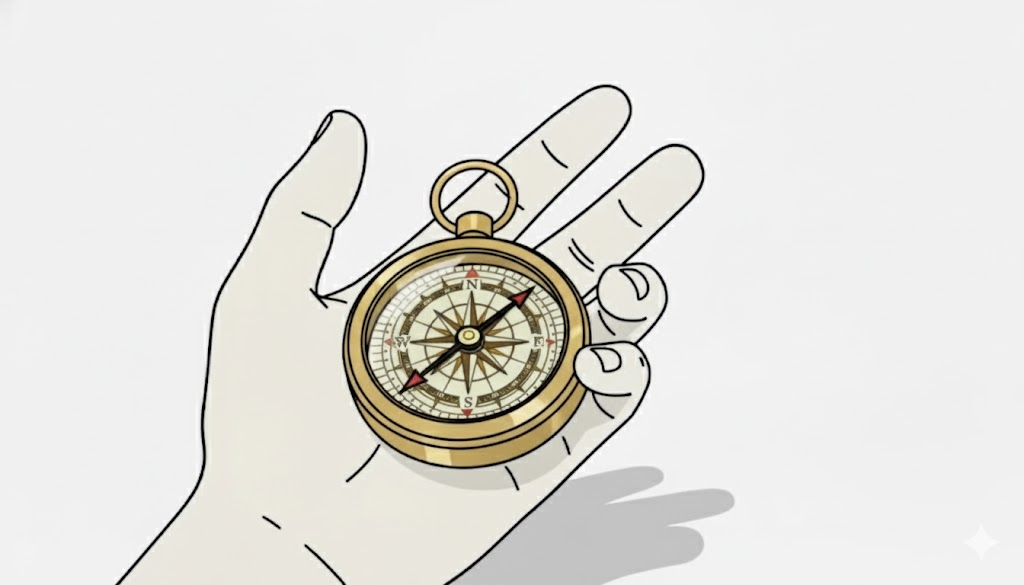
Choose your framework: Double diamond or continuous flow
There are two dominant frameworks for discovery: the Double Diamond and Continuous Discovery.
We follow these frameworks somewhat loosely at The Growth UX Studio because we strongly believe in customizing Product Discovery to every unique project and budget.
The Double Diamond—used widely across design teams—follows a structured arc: Discover → Define → Develop → Deliver. It encourages divergent thinking early on (exploring the problem space), followed by convergent thinking to identify the most viable solutions.
Continuous Discovery, championed by Teresa Torres, involves regular touchpoints with users to explore problems and test ideas in small, fast loops. Instead of one big discovery phase, you’re always learning.
For this case study with Lowe’s, we used the Double Diamond as our backbone, starting broad with open-ended interviews and card sorting, then narrowing in on information architecture and usability pain points. But we layered in Continuous Discovery habits as well – testing navigation updates and iterating with feedback as we built.
You don’t need to pick just one. Use the Double Diamond to structure your discovery, and Continuous habits to stay close to users as you go. Just like design, iterative product discovery will help you stay close to customers and users evolving needs and expectations. Because they change – as people get older, tech evolves, and other factors change how people want to use your product.
Lay the foundation: Building your discovery muscle
The best discovery work starts with clarity. Figure out what you want to learn. It’s best to remove any prescribed solutions from your mind.
Assemble the right team
At minimum, your discovery squad should include a product manager, a business partner, a UX designer, and a researcher (and/or strategist). In some cases, adding an analyst or developer early on helps frame constraints and surface opportunities.
Dig deep into problems—not predictions
Avoid assuming or “validating” the answer. Instead, collect wide-ranging evidence through:
- User interviews
- Card sorting
- Surveys
- Analytics and heatmaps
- Usability testing
- Competitor analysis
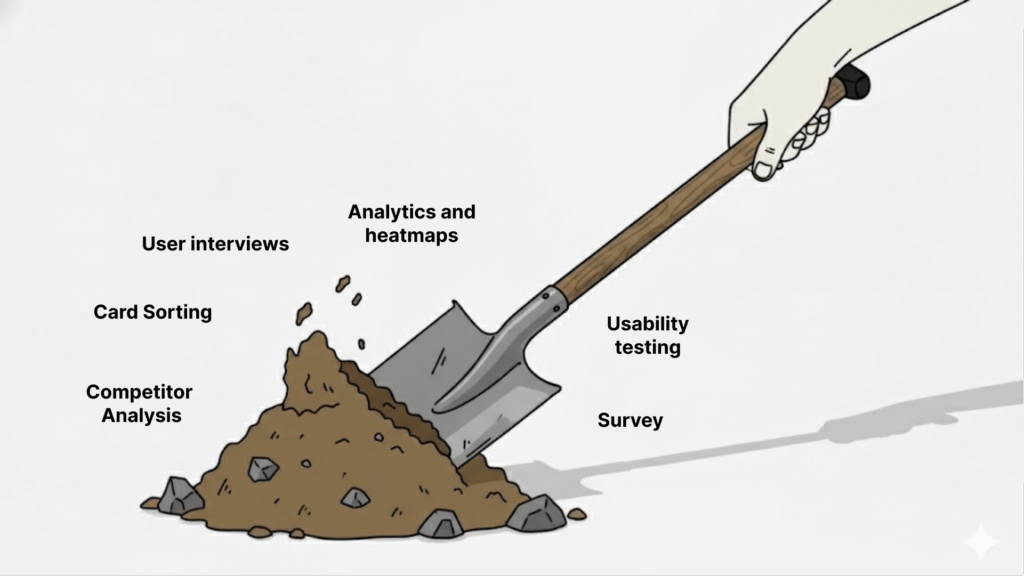
For Lowe’s navigation, we used open and closed card sorts to understand how users mentally organized categories, then ran moderated usability tests to watch how they navigated the site and competitor sites in real time. One clear pattern emerged: users were getting lost in overly broad or misaligned categories, and they craved a more use-case-driven path. (Which aligns with the personalized shopping experiences we’re seeing in more and more ecommerce stores.)
Here’s how to structure your discovery flow:
1. Understand & define
Once you’ve gathered data, it’s time to synthesize. We sift and cluster insights usually in a FigJam or Miro board in a way that is easily consumable and shareable throughout multi-disciplinary teams. We aim to incorporate a range of qualitative and quantitative data into the document, including user quotes and patterns observed in user expectations and behavior.
2. Ideate & Prototype
Translate your findings into possible solutions. Sketch multiple directions. Prototype quickly, even at low fidelity, and start pressure-testing your assumptions. You can prototype ideas quickly and easily today using AI tools like Claude, Figma Make, Bolt, etc.
3. Test and iterate
Discovery doesn’t stop at the idea stage. Now you need to test your ideas. Get your prototypes or wireframes in front of customers early to test and learn – are you solving meaningful problems?
Common pitfalls to avoid
Even teams who think they’re doing discovery fall into these trap:
Treating discovery as a one-off.
If you only do discovery once per project, you’ll miss new insights as user behavior shifts. Discovery is a habit, not a phase.
Starting with solutions.
Jumping straight into “what should we build” skips the most important part: understanding the problem.
Over-designing instead of clarifying.
When you truly understand the problem and remove the nlise, you can simply design what is essential and meaningful to your customers and users.
Testing too late.
Validate ideas early and often. You don’t need a polished prototype to test a concept. You need curiosity and users in the loop.
A sample discovery sprint
If you need to move fast, here’s a one-week format we’ve used with clients:
- Day 1–2: 6–10 customer interviews or card sorts
- Day 3: Affinity mapping and pattern analysis
- Day 4: Ideation workshop + wireframe creation
- Day 5: Usability tests and feedback synthesis
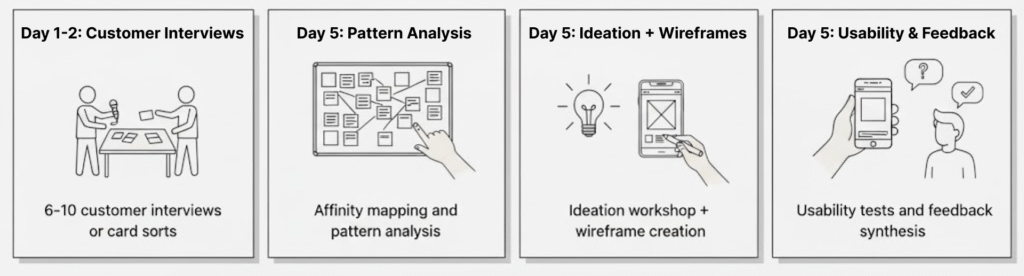
In just five days, you can generate actionable insights and validate your direction.
Growth UX take
Product Discovery isn’t just for startups. It’s (arguably) even more important inside enterprise environments, where legacy systems, competing priorities, and outdated assumptions can cloud decision-making.
Product Discovery should be the foundation to every project. It saves you from wasted effort, aligns your team, and surfaces user needs you didn’t even know were there. For us, discovery is how we turn big ideas into outcomes—faster, smarter, and with confidence.
Need a UX partner who understands business and designs for growth?
Let’s talk—Contact us today.