

Hiring is always going to feel like a gamble, and hiring senior designers is no exception.
There’s a wide range of skills and varying expectations a company has for their senior designers, usually a blend of hard and soft skills.
The main challenge is that most interviewers and companies don’t know how to assess soft skills. Most of them equate design with the end result — the design comps — and not all the strategic thinking, cross-functional collaboration, and process improvement that happened along the way.
In this guide, we’ll walk you step-by-step through the interview process for a senior UX designer, covering how to assess the soft, more intangible skills and qualities — the mindset, psychology, structure, and scoring — so you can make a more confident choice.
1. Why most UX interviews fail (and what to do instead)
The average UX interview process today feels like the wild west. There are likely too many vague and leading questions on your roster.
A better interview process for a senior UX designer asks intentional, thought-provoking questions to see how a candidate can think and answer critically. You can treat it like a UX challenge in itself.
Ask yourself:
- Who are your “users”? (Your candidates.)
- What data do you need to collect to make the right decision?
- What assumptions do you have before every interview — and how can you reduce bias and friction?
The psychology behind the interview process for a senior UX designer
A senior UX designer’s value lies in how they think just as much as what they produce. That means you’re not only hiring for design skills but for cognitive maturity and strategic behavior.
{Add table visual here}
A great interview process for a senior UX designer should reveal how a candidate solves problems when they need to navigate ambiguity, balance trade-offs, and influence others.
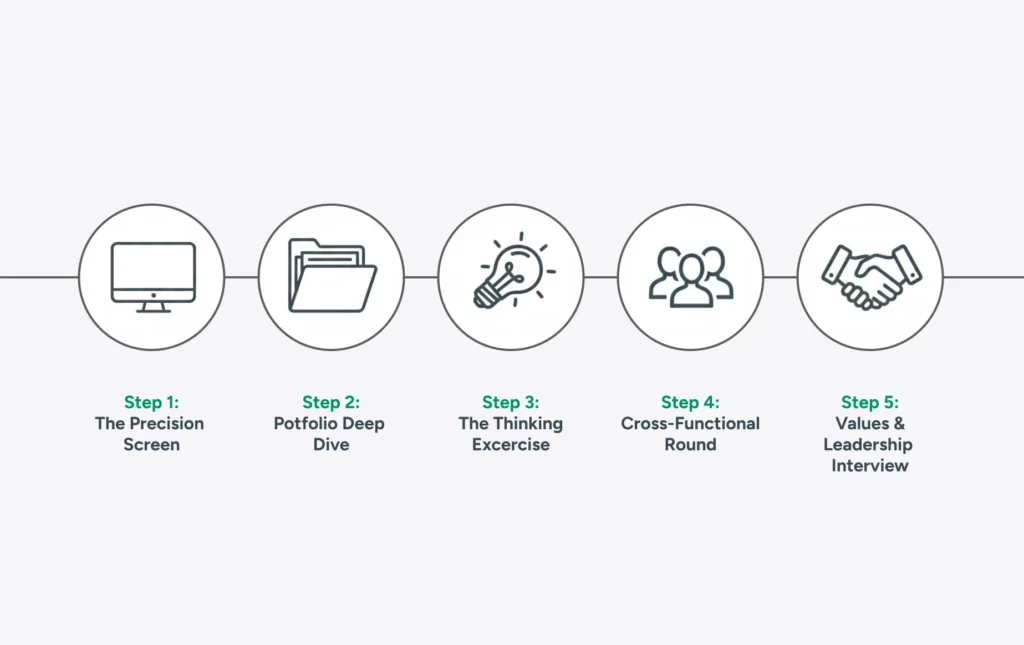
The 5-step interview process for a senior UX designer
This is a template meant to spark ideas and help you build something custom to what’s important to you. Feel free to adapt this process as much as you want.
Step 1: The precision screen
Ask one high-signal question:
“What’s the hardest product problem you’ve ever solved, and what made it hard?”
Listen for:
- Context over ego.
- Decision-making under constraints.
- Ownership of trade-offs.
You’ll know in two minutes if they’re worth moving forward.
Step 2: Portfolio deep dive
Instead of “Show me your best work,” ask:
“Show me a project where you can teach me about how you approach a project and problem.”
You’re assessing systems thinking, not surface-level aesthetics.
Ask:
- “What were the unknowns?”
- “What did you test?”
- “What surprised you?”
If they speak in verbs (validated, iterated, measured), they’re thinking deeply.
If they rely on adjectives (beautiful, intuitive, clean), they’re not yet operating at a senior level.
Step 3: The thinking exercise
Use a short, real-world brief, no speculative work.
Example:
“Our checkout flow loses 25% of users between Shipping and Payment. You have two sprints and no new features. What’s your approach?”
Observe:
- How they frame the real problem.
- How they prioritize and measure success.
- Whether they reference usability testing or data validation.
Senior designers will ask about constraints and structure ambiguity into action.
Step 4: Cross-functional round
This round tests collaboration and communication. Invite a PM and engineer alongside design leadership.
Ask:
- “Tell me about a time data and design expertise conflicted, what did you do?”
- “How did you advocate for users without losing business trust?”
A strong senior UX designer can align perspectives and lose their ego. They influence decisions across disciplines, not just within design.
Step 5: Values & leadership interview
End with leadership and mindset. Ask how they mentor others, handle feedback, and stay curious under pressure.
You’re looking for two things: intellectual humility and strategic confidence.
That’s the sweet spot of senior talent.
The psychology behind great hiring decisions
Design interviews expose biases, yours as much as the candidate’s.
Three to watch for in the interview process for a senior UX designer:
- Halo Effect: A beautiful portfolio can cloud judgment. Stick to rubrics.
- Confirmation Bias: Stay curious and open-minded; don’t look to validate your assumptions.
- Similarity Bias: People tend to hire people who think like them. But great design needs cognitive diversity and fresh perspectives.
Treat interviews as behavioral experiments: gather data, reduce bias, iterate the process.
What sets the senior UX designer mindset apart
Mid-levels seek direction.
Seniors create direction.
They connect metrics to empathy, data to design, and people to outcomes. They’re confident but never rigid, willing to pivot when evidence changes.
That’s why your interview process for a senior UX designer must test both their mindset and their method.
Candidate experience = UX experience
Your hiring process is your brand’s UX.
This is super important — top candidates will judge you by how well you communicate, organize, and follow through. If you want to attract top talent, you need to whip your hiring process into shape.
A few quick wins:
- Provide clear timelines and structured rounds.
- Offer a scoped live challenge, not free work.
- Be transparent about evaluation criteria.
- Give feedback promptly, even to rejections.
When your interview process reflects empathy and clarity, it attracts better designers and strengthens your employer brand.
What teams see after fixing their interview loop
(Based on composite outcomes reported across high-performing UX teams who’ve shifted to structured, behavioral interviewing):
- Faster, fairer decisions — clear rubrics reduce bias and debate.
- Better onboarding — hires ramp faster when your process reflects real working conditions.
- Less design-to-dev rework — systems thinkers anticipate feasibility early.
- Stronger cross-functional trust — teams feel invested in the hire.
- Improved candidate experience — clarity and respect build reputation.
TL;DR
- Define success criteria before sourcing.
- Use structured behavioral questions. Don’t worry about sounding cliché, people expect them.
- Add a live, time-boxed thinking session.
- Involve PMs and engineers early.
- Close fast and communicate clearly.
And that’s your green-light framework for the interview process for a senior UX designer.
The science behind “Design thinking under pressure”
Studies from MIT’s Cognitive Systems Lab show that designers with strong metacognition (awareness of their own thinking) make faster, smarter trade-offs under pressure.
We have mixed feelings about this, because while it’s valuable to know how a senior designer organizes their thoughts under pressure, some great designers just don’t interview well. It’s useful to ask beforehand if the designer needs any accommodations or if there’s anything you should keep in mind during the interview.
Storytime, sr. designer mic. drop.
A few years ago, during a high-stakes senior UX designer interview at a major streaming company, every candidate presented flawless visuals.
Then one woman did something unusual. When asked to “design a new feature to boost engagement,” she paused for ten seconds and said:
“I wouldn’t add a feature yet. I’d start by removing two.”
Silence.
She explained:
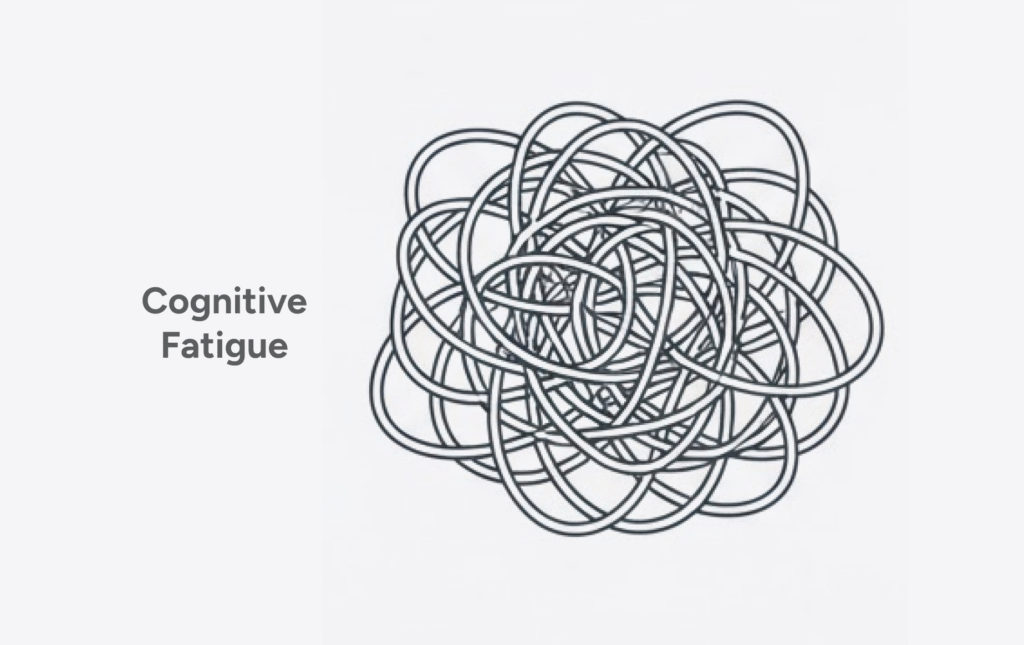
“Your engagement drop isn’t a UI problem, it’s cognitive fatigue. The homepage is overloaded. I’d start by simplifying decision-making, run a quick card-sort test, reduce visual noise by 40%, and measure exploration time.”
No wireframes. No prototypes. Just strategy.
She got the offer the next day. Six months later, her redesign cut bounce rate by 18% and increased repeat sessions by 25%.
That’s what a true senior designer does.
Final thoughts
Longer interviews and more rounds aren’t the answer for the interview process for a senior UX designer. The answer is asking better questions, removing bias, and testing for systems thinking.
If you want to see how strategic UX hiring and design processes scale across enterprise and startup environments:
Need a UX partner who understands business and designs for growth?
Let’s talk—Contact us today.